
One of the great wildlife shows on earth, happening right here in winter
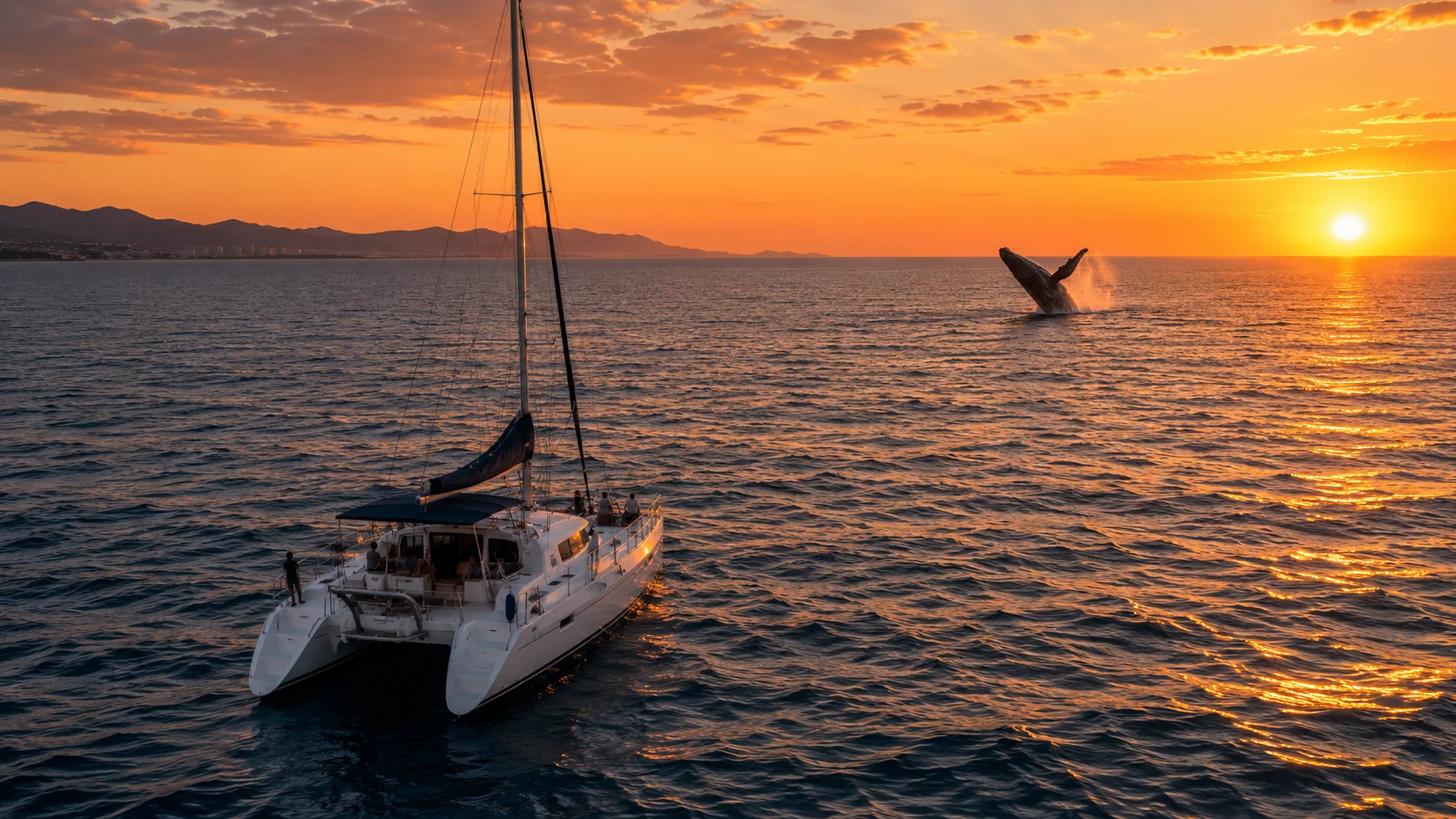
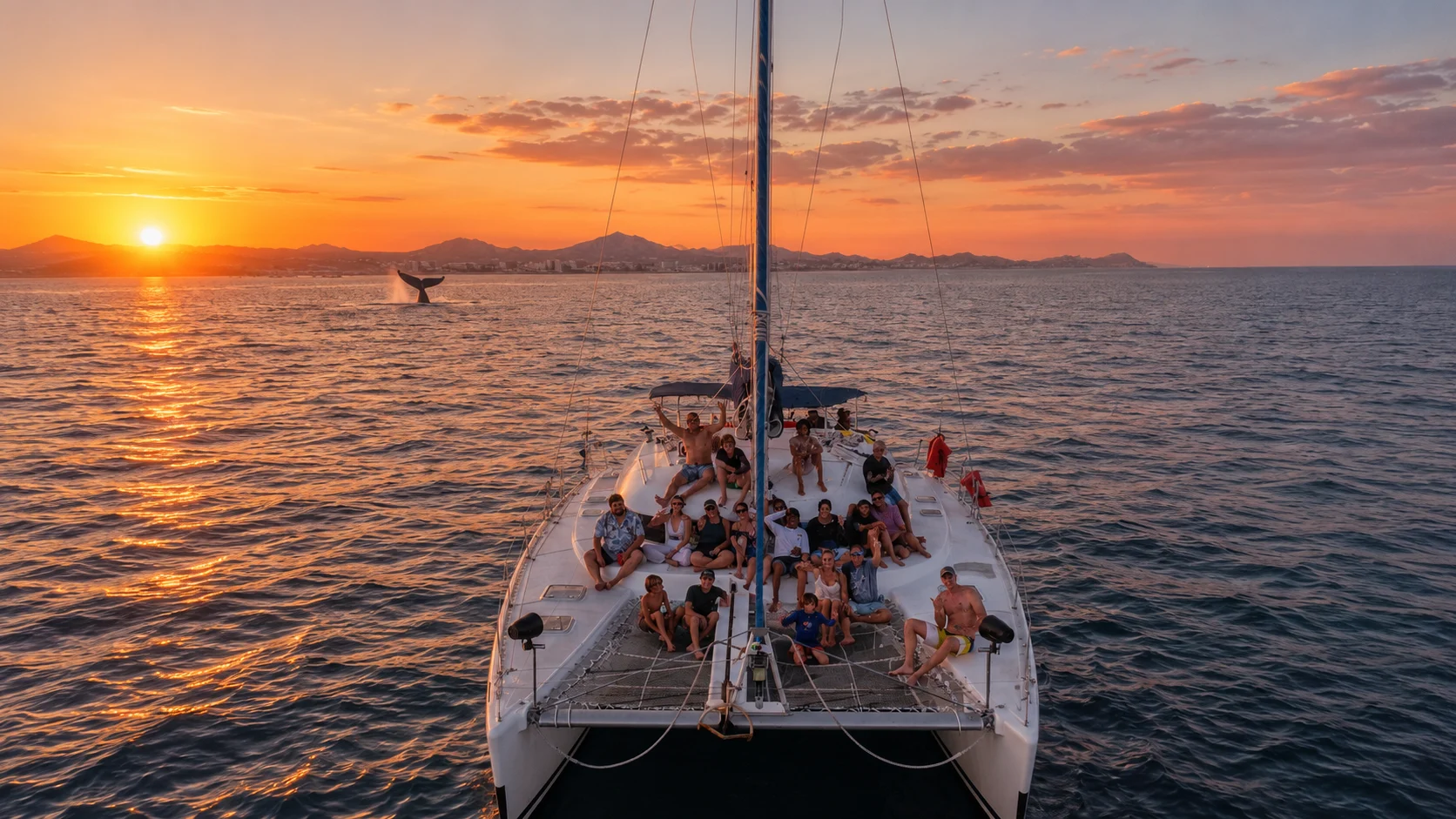
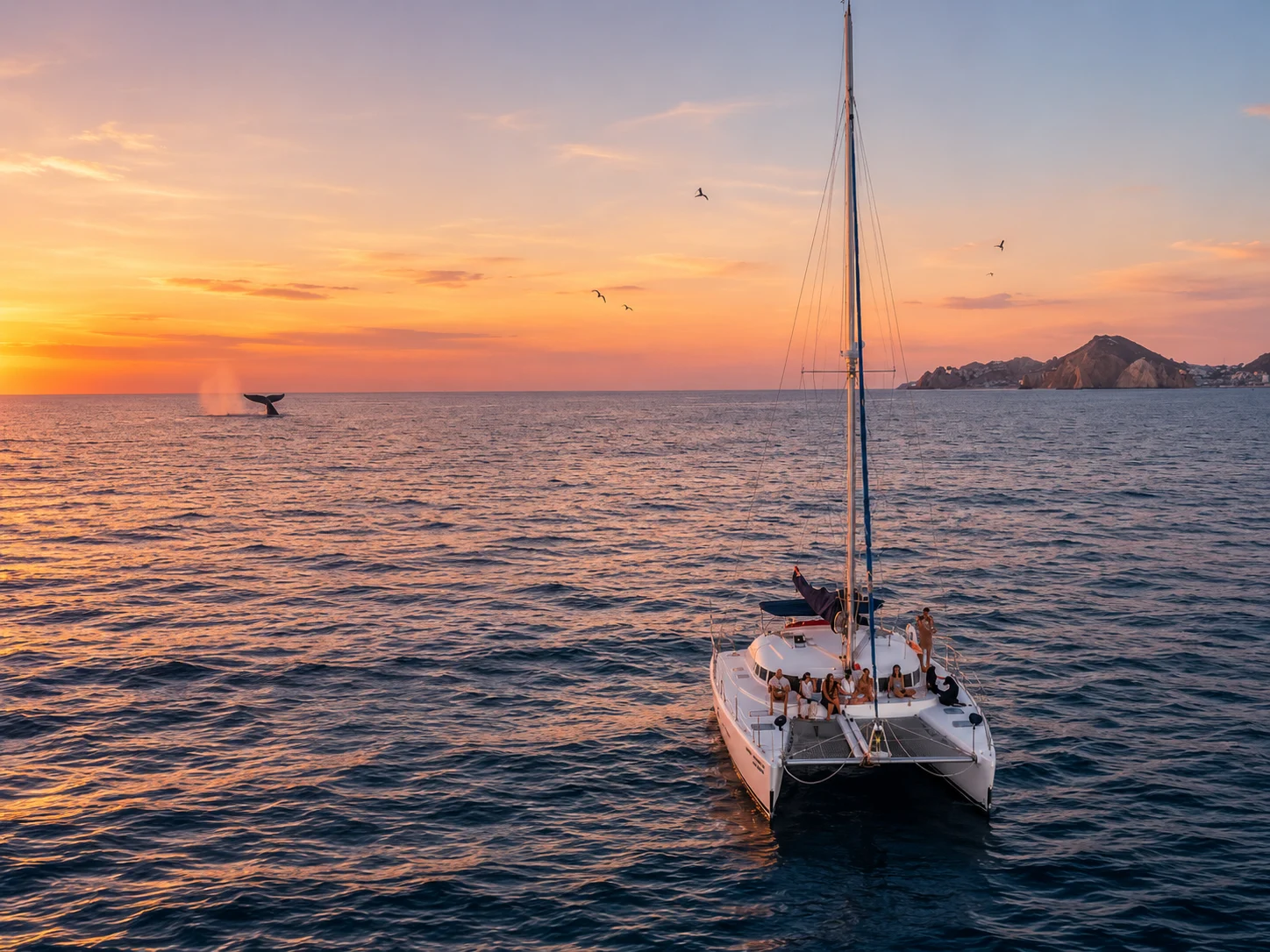
Cabo San Lucas sits directly on the migration path of humpback and gray whales traveling annually from the cold feeding grounds of Alaska and the Bering Sea to the warm sheltered waters where the Pacific meets the Sea of Cortez. From mid-December through April, and especially in the peak months of January, February and March, these waters fill with mothers nursing calves born just days or weeks earlier, males competing aggressively for the attention of females, and breaching behavior so dramatic it does not feel real even when it is happening 30 meters away from your catamaran. Our 3-hour whale watching tour aboard a 43-foot catamaran takes up to 23 guests directly into the action.
Whale watching in Cabo San Lucas is not like whale watching in many other places. There is no need to travel hours offshore, the whales come right to the bay, often visible from the beach and routinely within ten minutes of the marina. The Sea of Cortez itself was designated a UNESCO World Heritage Site in 2005 in part because of its extraordinary marine biodiversity, including the highest concentration of cetacean species (whales, dolphins and porpoises) of anywhere on the planet. The fact that you can be on a comfortable catamaran with a margarita in your hand and a humpback breaching close enough to soak your foredeck is genuinely one of the rare experiences modern travel still offers.
Our captains have years of experience reading whale behavior in these waters, they know which areas tend to attract the most activity at different times of the season, how to position the catamaran for the best viewing without disturbing the animals, and how to interpret the behaviors that signal a whale is about to breach versus simply traveling. They follow Mexican federal regulations strictly (more on that below) while giving you the best possible chance of an unforgettable encounter. The tour includes everything you would expect from a Sail Baja Adventures experience: premium open bar, food prepared on board, warm blankets for the cooler morning departures, and a bilingual crew that knows what they are doing.
Five Species · One Coastline
Who you might see
Five different species of whales can be encountered in the waters around Cabo San Lucas during winter season, with two of them, humpbacks and grays, making up the vast majority of sightings. The other three are rarer but possible, and seeing any of them is the kind of experience that turns into a lifelong memory. Here is what to know about each.
Humpback Whales Dec to Apr · Up to 50 ft
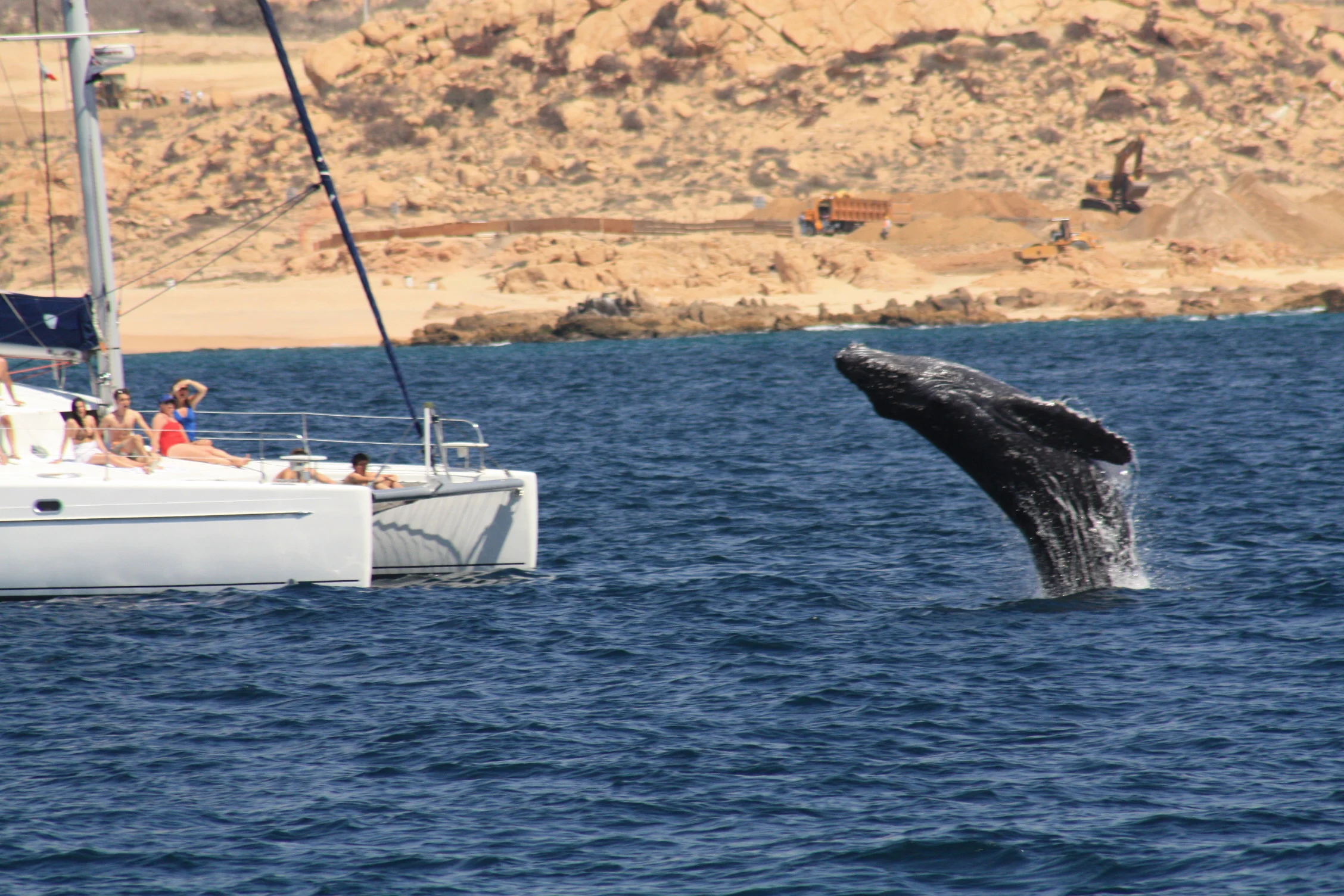
The humpback (Megaptera novaeangliae) is by far the most commonly sighted whale in Cabo San Lucas during the winter season. Adults reach lengths of 45 to 50 feet and weights of up to 40 tons. They migrate from feeding grounds off the coast of Alaska and British Columbia, a journey of more than 3,000 nautical miles each way, to mate and give birth in the warm waters of Baja. Humpbacks are famous for their acrobatic behaviors: full-body breaches where they launch most of their mass out of the water, pectoral fin slaps that can be heard from a mile away, and tail lobbing that sends spray dozens of feet into the air. The males also produce the longest and most complex songs of any non-human animal, lasting up to 20 minutes and audible underwater for many miles. Babies are born in January and February.
Gray Whales Jan to Mar · Up to 49 ft
The gray whale (Eschrichtius robustus) makes the longest mammalian migration on earth, from the Arctic Ocean to the lagoons of Baja California Sur, a one-way journey of about 6,000 miles. Mexico is the only place in the world where gray whales come to breed, which makes Cabo a genuinely unique destination for seeing them. Adults are slightly shorter than humpbacks but often appear larger because of their massive heads. They are often spotted in small groups close to shore, sometimes within a few hundred meters of the beach, and they are famously curious about boats. So-called “friendly grays” in the nearby Magdalena Bay and San Ignacio lagoons regularly approach boats close enough to be touched, though that level of interaction does not happen at our standard tour areas.
Blue Whales Peak season · Up to 100 ft
The blue whale (Balaenoptera musculus) is the largest animal that has ever existed on earth, larger than any dinosaur, with a heart the size of a small car and a tongue that can weigh as much as an elephant. Adults reach 100 feet long and 200 tons. The Sea of Cortez hosts a known population of blue whales during the peak winter months, though sightings are rare and unpredictable. If you do see one, you will remember it for the rest of your life. The sheer scale of a blue whale at close range is something that no documentary footage prepares you for.
Sperm Whales Occasional · Up to 60 ft
The sperm whale (Physeter macrocephalus) is the largest toothed predator on earth and the species made famous by Herman Melville’s Moby Dick. They are present in the Sea of Cortez year-round, though sightings during the winter tours are less frequent than the migratory species. Sperm whales are deep divers, they routinely dive to depths of 1,000 to 2,000 meters in pursuit of giant squid, and they spend long periods on the surface between dives, which is when they are visible to boats. Their massive square-shaped heads and distinctive forward-angled blow make them unmistakable when you do see one.
Orcas, or Killer Whales Rare · Up to 32 ft
The orca (Orcinus orca) is technically the largest member of the dolphin family rather than a true whale, but they are spectacular when they appear. Pods of orcas pass through the southern Baja waters occasionally, usually following migrating prey species. They are apex predators with complex social structures and distinct cultural behaviors that vary from pod to pod. An orca sighting in Cabo is rare enough that we will absolutely call it out from the deck, and our captain will give the pod a wide berth out of respect.
Month by Month
When to come for the best whale watching
Whale watching season in Cabo San Lucas runs from mid-December through April, but the experience varies significantly across those months. Here is a breakdown of what to expect month by month, so you can time your trip to match the kind of encounter you are hoping for.
December: the season begins
Humpbacks start arriving in mid-December after their long migration south. Numbers build through the month, and by the last week of December most of the population is in residence. Early-season tours sometimes have lower whale densities than peak months, but they also have fewer crowds and more space on the water. The first mother-and-calf pairs typically appear in the last week of December.
January: peak gray whale activity
January is when gray whale activity reaches its peak in the region, and humpback populations are at full strength. Babies of both species are being born, which means mother-and-calf pairs are everywhere and they are protective, which often triggers more dramatic surface behaviors. Blue whales begin to appear later in January. This is one of the best months for variety: you might see three or four different species in a single 3-hour tour.
February: prime time
February is widely considered the absolute peak of the whale watching season in Cabo. Multiple species are present in maximum numbers, breaching activity reaches its highest levels of the year, and mother-and-calf pairs are everywhere along the coast. Tours fill up fast in February, book several weeks in advance if possible.
March and April: northward migration begins
By mid-March, the gray whales start their long return migration toward Alaska, but humpbacks remain abundant through most of April. Conditions on the water are often calmer in March and April than in the peak winter months, which makes for more comfortable sailing and better visibility. Tours are easier to book, prices on accommodations drop, and the experience is still excellent. For travelers with flexibility, the shoulder months of late March and early April offer a great balance of quality whale watching and lower demand.
Ethical Whale Watching
Wildlife first. Photos second.
Whale watching in Mexico is regulated by federal law (NOM-131-SEMARNAT-2010), and Sail Baja Adventures follows every requirement carefully. The rules exist for good reasons: whales are wild animals making essential biological journeys, and irresponsible boat behavior can disrupt feeding, breeding, and mother-calf bonding in ways that have lasting consequences for the population.
Mexican regulations require a minimum distance of 80 meters between boats and adult whales, and 240 meters between boats and mothers with calves. Boats are not permitted to chase whales, surround pods, cut off their travel direction, or remain in the same observation area for more than 30 minutes. Engines must be slowed to idle or off when whales approach. Our captains follow these rules strictly, and frankly, we are happier doing it that way. Whales are curious creatures. When you give them space, they often come closer to the boat on their own, which produces the best possible encounter for guests without any disturbance to the animal.
You will still see incredible things. Most of our tours produce multiple close-up encounters, sustained surface activity, and at least one breach or tail-slap close enough to soak the foredeck. We will always prioritize the wellbeing of the whales over the perfect Instagram shot, and we ask our guests to do the same.
Whale Watching FAQs
When is whale watching season in Cabo San Lucas?
Whale season runs from mid-December through April, with peak activity from January through March. This is when humpback and gray whales are most active. breaching, tail-slapping, and nursing their calves in the warm waters where the Pacific meets the Sea of Cortez. If you are visiting during these months, do not skip this tour.
What whale species can we see?
Humpbacks are the most common, showoffs that love to breach. Gray whales arrive in January and are often spotted in small groups near shore. In peak months (January to February) you may also encounter blue whales, sperm whales, and occasionally orcas. One of the few places on earth where multiple species show up in a single outing.
Is a whale sighting guaranteed?
We operate during peak season and our captains know exactly where to find them. Sightings are extremely common, but whales are wild animals and the ocean is their territory. We can promise you will be in the best possible position to see something incredible. Most tours do not come back empty.
What time of day is best for whale watching?
Morning tours offer the calmest conditions and best visibility, great for families or anyone prone to motion sickness. Afternoon tours tend to have more wind and wave action, which often triggers more dramatic behaviors like breaching and pectoral fin slapping. Both are excellent, it depends on what you are after.
Is the Whale Watching Tour good for kids and families?
Yes, seeing a 50-foot humpback breach 30 meters from a catamaran is the kind of thing kids talk about for years. Our catamarans are stable and spacious with plenty of room to move safely. Morning departures are calmer, which makes them the better option for younger guests.
How close do we get to the whales?
Mexican law requires a minimum distance of 80 meters from whales (mothers with calves require 240 meters). But whales are curious, they often approach the boat on their own. Sometimes they surface right next to us. Our captains follow regulations strictly while positioning for the best possible viewing.
What is included in the Whale Watching Tour?
A bilingual crew experienced in reading whale behavior, premium open bar, food on board, and warm blankets for early morning or winter departures. We also pass by El Arco and the sea lion colony on the way out, the sightseeing starts before we even reach the whales.